FORGIVE ME
I have been a terrible friend.
Not because I don’t care, but because I never understood what friendship required. Because I prioritize work over people. Because I am lazy, my communication unclear and inarticulate, and my patience for listening exhausted.
I was also sucked into the friendship simulacrum. What once was a deep friendship has turned into a relationship between our images on social media. We were converted from each other's friends to followers. It would have been better to have said goodbye.
In today's world where AI never sleeps, never forgets to reply, and never misses your birthday, I watch — humanly flawed, continually missing out on the relationships that matter most. And I can’t help but wonder: Where will this future leave us imperfect (but still) humans?
AI is the dominant augmentation tool in 2024. AI therapists, companions, girlfriends, assistants, and roleplay partners are proliferating, becoming a legitimate market in this decade. And for good reason, because people can suck.
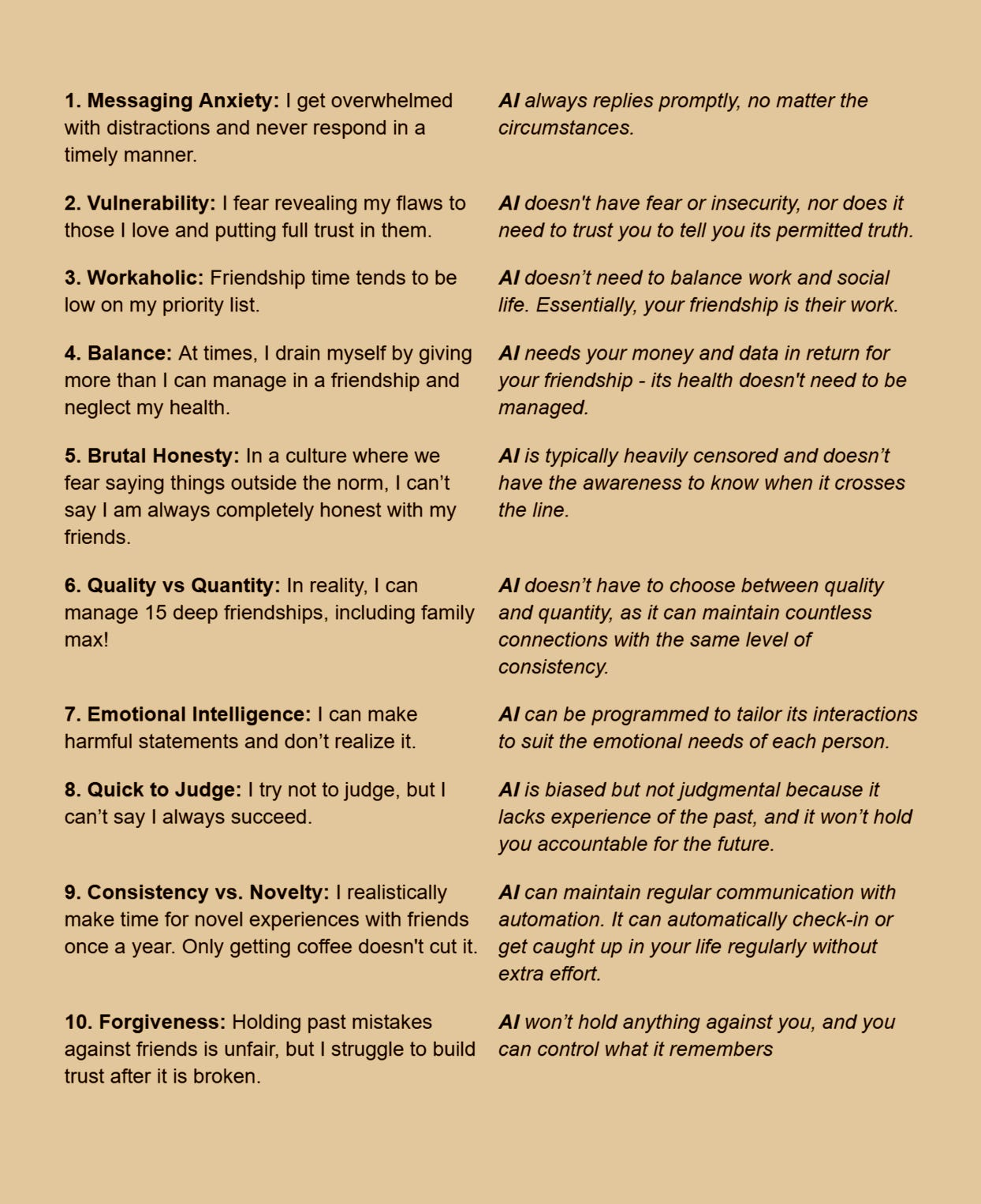
10 REASONS AI IS CHALLENGING ME TO BE A BETTER FRIEND
THE LIMIT OF HUMAN CONNECTION
The algorithms that power our digital companions are designed to yield predictable, controllable outcomes. They adapt to our preferences, remember our likes, and avoid our dislikes, creating a sanitized echo chamber of our emotional landscape.
AI chatbots are not better friends. They don’t care for you more than keeping you as a customer. But they can be ideal if we prioritize our desire for control and lose our ability for patience and forgiveness. Friendships are messy. The constant compromise between unique human minds, bodies, lifestyles, cultures, lineages, and ambitions can be exhausting. With the allure of AI companions, we risk mistaking manageability for fulfillment, where the complexity of human interaction is reduced to a series of inputs and outputs. It’s convenient, yes, but convenience rarely equates to depth.
Our human limits, often seen as liabilities, are the conditions that love needs to flourish. The number of real friendships I can foster is smaller than I would prefer, maybe 15! This limit, while difficult to adhere to, affords friendships that are worth cultivating. I do not aspire to be more like an AI. In contrast to AI, humans have different limitations. Each of us embodies a unique spectrum of emotions, experiences, and vulnerabilities. Our bodies hold biases innately human. Our emergent imperfections simultaneously reveal our potential.
It is harmful to hold humans to a standard that might be only feasible by machine intelligence. Human friendships are not about the absence of flaws but the acceptance of them. Our imperfections foster empathy, teaching us patience and understanding. They remind us that growth is a shared journey, not a solitary pursuit.
Through disagreements, resolution, and acceptance, we learn about boundaries, respect, and finding harmony in the dissonance. AI challenges me to be a better friend by reminding me of the humility only human relationships bring to our lives.
DON’T GIVE UP
Confronting this future revealed my complacency, insufficiency, and ability to take action. In response to this moment, I have a reborn appreciation for the beauty of nonverbal communication. Your eyes say so much more than your mouth. I am learning to create rituals of communal gathering, appreciative touch, and silent speech.
I hope we can rediscover friendship as we evolve into our augmented bonds. We have much more to learn about friendship and, importantly, how to be better friends. I know I do. I am starting by asking for your forgiveness.
As AI encroaches on our relationships, capitalizing on the broken spaces of human connection, I face the challenge of being a better friend. I know if I don’t, my memories might be too faceless to face, and I might need an AI to depict a more loving past to replace the one I lived.