

“The saddest aspect of life right now is that science gathers knowledge faster than society gathers wisdom.” ― Isaac Asimov
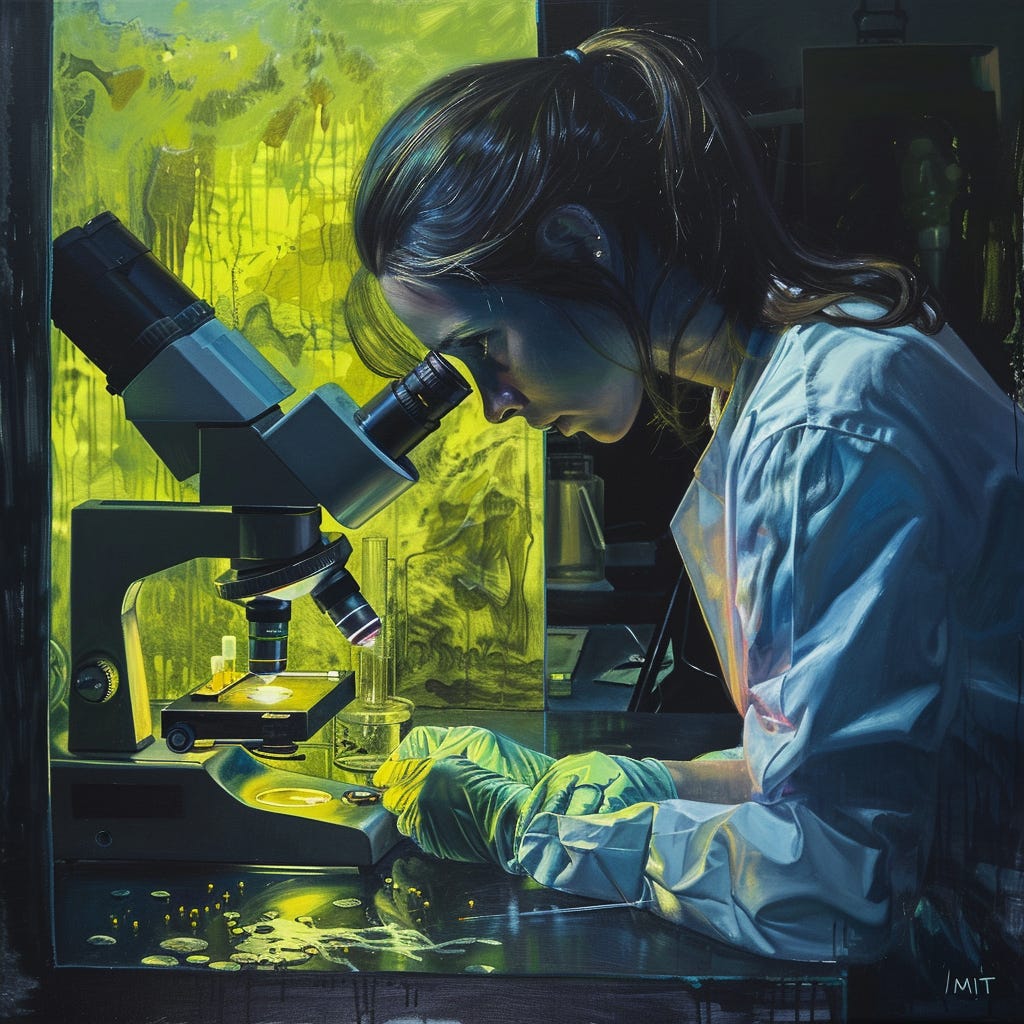
Transfixed, I stood peering through the eerie neon green and yellow windows of the MIT nano lab. Within, a young scientist hunched over her microscope, her very body seemingly fused with the instrument. Her eyes, likely bloodshot from strain, remained fixed on the eyepiece. As I watched her, a chill ran down my spine. What secrets was she uncovering in that microscopic universe? Cures for cancer or blueprints for the next bioweapon?
Science, once humanity's miracle that brought us an age of Enlightenment, now stirs heated arguments on subjects such as climate change to synthetic biology. From the Cold War's nuclear nightmares to today's AI arms race, knowledge unleashed by science has become a double-edged sword. Wielded by the powerful, tainted by military might and corporate greed, scientific pursuit has lost its halo. Where we once saw scientists as having noble intentions, the public is now disillusioned and distrustful.
Before you toss out all of your college textbooks, let's get one thing straight - we need science. But we've built walls around knowledge and turned professions into an exclusive specialized club. You're either in, or you're out. The public is rightfully skeptical. When was the last time you met someone (who is not a biologist) who could explain how the COVID-19 vaccine actually works? We've made rocket science out of, well, everything. But in the age of the internet, ignorance does not have to be your fate.
An Era of Citizen Scientists
Now, how do we resurrect trust in an institution so thoroughly entwined with capital and political power from institutions such as the United States defense organization DARPA? The answer lies not in further isolation. We must tear down walls of elitism and make everyone a scientist. Yes, you read me right -- the plumber, the politician, and the kid flipping burgers. This isn't about turning everyone into Einstein. It's about giving people the tools to think, to look at a problem and say, "I can figure this out." The extreme specialization of scientific knowledge has bred an exclusivity that fuels fear and resentment. By democratizing this understanding, we can dispel the mists of ignorance that shroud breakthroughs like the COVID-19 vaccine in suspicion.
We must forge a new breed of citizen scientists, individuals who transcend the boundaries of their primary professions to grasp the fundamental principles of scientific inquiry. This is no utopian fantasy but a necessary evolution of our educational paradigm.
Scientific literacy isn't just about understanding the world around us—it's a critical driver of economic prosperity and innovation in our increasingly technology-driven global market. Countries with higher levels of scientific literacy consistently outperform their peers in economic indicators and technological innovation. The United States, China, and Germany—three of the world's largest economies—are also among the top producers of scientific research.
Scientifically literate citizens are more likely to engage in public discourse on critical scientific policy agendas. The Danish Board of Technology's consensus conferences, where citizens deliberate on complex technological issues, exemplify how an informed public can contribute to policy formation. These initiatives have influenced Danish policy on topics ranging from electronic patient records to genetically modified foods.
The intersection of science and policy has never been more critical. From climate change legislation to public health measures, scientifically informed policy decisions are essential for addressing today's most pressing problems.
Media Responsibility
However, scientific literacy doesn't exist in a vacuum—it's heavily influenced by how science is communicated to the public. This is where media responsibility needs serious critique and potentially new regulations. In an era of clickbait headlines and sensationalized reporting, the nuanced communication of scientific findings often gets thrown in the bin.
News coverage of scientific issues often overemphasizes the certainty of findings or conflates correlation with causation. This can lead to public misconceptions and erode trust. The infamous case of Andrew Wakefield's discredited study linking vaccines to autism, which received disproportionate media attention, illustrates the potential consequences of irresponsible science reporting.
Responsible science journalism requires more than just accurately reporting facts. It involves contextualizing findings, explaining methodologies, and conveying the inherent uncertainty in scientific research. Initiatives like the Science Media Centre in the UK, which connects journalists with scientific experts, represent positive steps towards improving the quality of science reporting.
At its core, the scientific method is a structured approach to questioning, observing, hypothesizing, testing, and analyzing. These skills are invaluable whether you're debugging software, managing a team, or deciding which candidate to vote for.
By forming hypotheses and systematically testing them, individuals can make more informed choices, from financial investments to career moves. The scientific method's emphasis on evidence-based conclusions serves as an antidote to the spread of misinformation. In an era of "fake news" and social media echo chambers, the ability to critically evaluate claims and seek verifiable evidence is more crucial than ever.
Our Transdisciplinary Future
To harness these benefits, we need a radical overhaul of our educational system. It is often siloed into distinct subjects and fails to reflect the interconnected nature of real-world challenges. We must shift towards a transdisciplinary approach that integrates scientific thinking across all subjects at all ages, such as NASA’s Citizen Science projects, in which ordinary people contribute to scientific discovery. Other examples include the community biology labs and fabrication labs that are proliferating around the globe which democratize access to equipment once exclusive to a university environment. The goal is basic scientific literacy and knowledge of critical safety procedures, not necessarily expertise in all fields. These initiatives aren't just changing education—they're redefining who can be a scientist.
Our culture of endless scrolling must give way to a thirst for substantive knowledge. We must harness the democratizing power of the internet to obliterate the walls of institutional elitism, creating transdisciplinary thinkers capable of independent inquiry and critical analysis. The antiquated idea that you can only be in one specialty or profession was born from the Industrial Revolution of the 20th century. In the Digital Revolution of the 21st century, we need people who can straddle worlds, speaking multiple languages of science, policy, and humanities.
We need transdisciplinary citizen-scientists to rebuild the bridge between science and society. This would ensure that scientific knowledge, rather than getting stuck in the lab, can be safely applied in society with the trust of informed citizens. This journey begins in our classrooms, extends through our media, and culminates in a society where scientific thinking is as natural as walking. The challenges we face - from climate change, nuclear energy, space exploration, and future pandemics - demand nothing less than a populace equipped with the patience, skills, and fearlessness to learn the truth for themselves.